


The Birth of the Eixample: Barcelona's Most Iconic Neighbourhood
Picture Barcelona in the mid-1850s, a city still encircled by ancient fortified walls, dense, overcrowded, and straining against its own boundaries. Walking its narrow medieval streets today, it's easy to forget that everything you see once ended abruptly at those walls, beyond which there was simply no more city. The problem was obvious: there was not enough room for everyone. And so, a plan arose for an entirely new district.
If you're staying with us on Carrer Girona, you're already living inside that plan. Step outside our door and you're walking the grid that one visionary engineer spent his life imagining.
The Birth of the Eixample, Barcelona's most iconic neighbourhood

Ildefons Cerdà: The Man Who Designed the Eixample (The Birth of the Eixample: Barcelona's Most Iconic Neighbourhood)
(A note on spelling: the district is written Eixample in Catalan pronounced roughly "esh-AM-pluh" and Ensanche in Spanish. You'll see both in the city, though Eixample is the form used today.)
Ildefons Cerdà, the Catalan form of his name, which you'll also see written as Ildefonso Cerdá in older Spanish sources, was an engineer whose ideas still provoke debate among architects and urban planners. He was, by any measure, a utopian. That quality is precisely what allowed him to think beyond the walls entirely.
His ambition wasn't just to build more streets. He wanted to close the gap between Barcelona's rich and poor neighbourhoods, to design a city on principles of equality. He envisioned broad avenues, shared green spaces at the heart of each block, and buildings capped at 16 metres (four floors) so that no one would be left in permanent shadow.
In 1867, he published his most important work, The General Theory of Urbanization, a book that effectively invented the word "urbanisation" as we understand it today, and became the blueprint for modern Barcelona.
His plan divided the city into equal octagonal blocks, their famously chamfered corners serving a practical purpose: they improved sightlines at intersections and gave vehicles easier turning angles. These same cut corners, and the wide streets between them, also laid the foundation for something Cerdà could never have anticipated — Barcelona's thriving cycling infrastructure. The lanes that carry bikes through the city today follow the logic he drew on paper in the 1850s.
The connection to the present goes further. Barcelona's modern Superilles (Superblocks), the traffic-calming "green hubs" that have been quietly reshaping the city's streets, are in many ways a return to Cerdà's original vision of pedestrian priority and shared neighbourhood space. The grid he designed was always meant to breathe. If you want to explore what the Superilles mean for visitors today, our piece on [Sustainable Travel in Barcelona] picks up where this history leaves off.
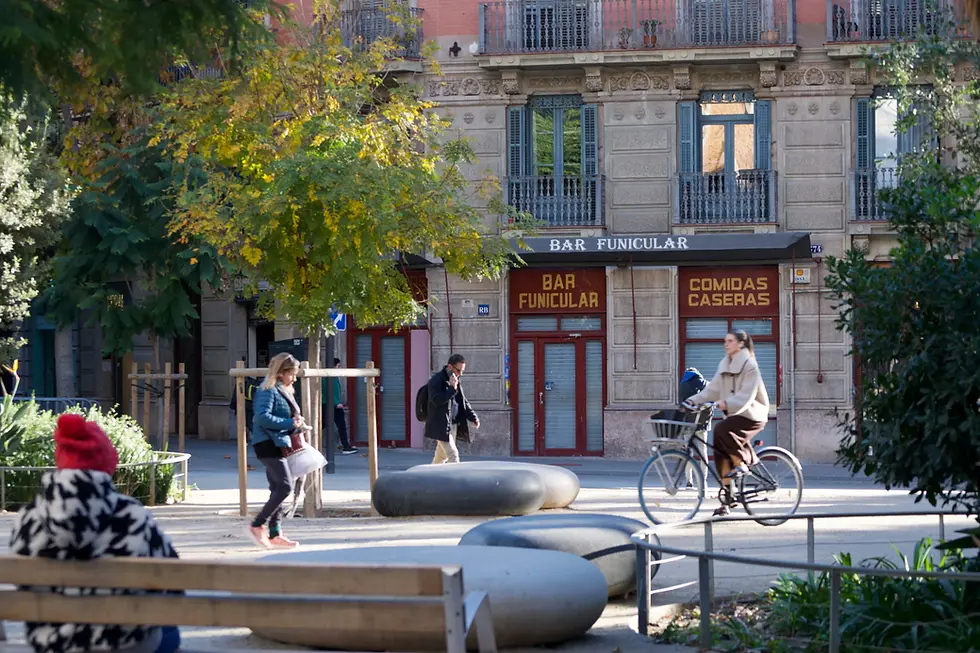
The Eixample Grid: How Barcelona's Streets Were Planned
As with most utopian plans, reality intervened. The building height cap of 16 metres was breached almost immediately. Developers and a growing bourgeoisie pushed for taller buildings, more floors, and higher returns. City authorities largely acquiesced. The internal courtyard gardens that Cerdà had designated as communal green lungs for each block were gradually built over. What you walk through today is a modified version of his dream: the geometry survived; much of the social idealism did not.
It's a tension that makes the Eixample worth reading as you walk it — a neighbourhood that is simultaneously one of the great achievements of urban planning and a reminder of what gets lost when commerce meets idealism.
The 1888 Exhibition and the Eixample's Golden Age

The World's Fair of 1888 was the spark that accelerated everything. Held across a vast site near the Arc de Triomf (which served as the main entrance), the Parc de la Ciutadella, the zoo, and what is now the Estació de França, the exhibition gave Barcelona a deadline and a global audience. New infrastructure, new buildings, and new confidence poured into the city.
The Ciutadella Park, redesigned as the exhibition's centrepiece, was transformed by architect Josep Fontserè, who worked with the existing bones of the old military citadel, its chapel (now a military parish), the governor's palace (now the IES Verdaguer secondary school), and the armory (now the seat of the Parliament of Catalonia), into something entirely new.
The exhibition also seeded the ground for Modernisme — the Catalan architectural movement that would go on to define Barcelona's visual identity. Of the buildings constructed for the fair, only a handful survive: the Arc de Triomf by Josep Vilaseca, the Castle of the Three Dragons by Lluís Domènech i Montaner (originally a café-restaurant, now the Zoological Museum), the Geology Museum by Antoni Rovira i Trias, the Hivernacle (glasshouse) by Josep Amargos, and the Umbracle (shade house) by Fontserè. Fragments of the Gallery of Machines by Adrià Casademont i Vidal are still visible, repurposed for zoo services.

Carrer Girona: The Eixample's Architectural Showcase
The energy of the exhibition didn't stay on the fairground. It spread outward through the new Eixample, and Carrer Girona, the right side of the district, became one of its most expressive streets. For a closer look at the street's full architectural story (building by building) read our dedicated guide to [Carrer Girona].
There are the two buildings by Enric Sagnier i Villavecchia that give Carrer Girona much of its particular character. Sagnier was one of the most prolific architects working in the right Eixample during this period, building largely for Barcelona's prosperous bourgeoisie. His early work at Carrer Girona 20, Casa Antoni Roger Vidal, on the corner with Carrer d'Ausiàs Marc 33–35, showcases the eclectic turn-of-the-century style he was developing at the time. A few doors along, his later building at Carrer Girona 24, Casa Enric Roger Vidal, is a more resolved expression of early Catalan Modernisme, announced by a towering wooden front door and a grand double-sided marble staircase that still impresses the moment you step inside.
That second building is where we are.

Staying in the Eixample: Hostal Girona
Two floors of Casa Enric Roger Vidal are home to Hostal Girona. When it was opened, the intention was simple: to offer guests a place with personality and history, not just a place to sleep.
The rooms blend modern comfort with the details that were here long before us — chief among them the Nolla mosaic floors. Named after Miquel Nolla, the Valencian entrepreneur who first produced these geometric hydraulic tiles in Valencia in 1860, the patterns underfoot are the same ones that graced the apartments of Barcelona's 19th-century bourgeoisie. We've worked to restore as many as possible.
The building's original elevator, installed by Enrique Cardellach and his brother Fèlix, Fèlix Cardellach being a notable figure in the Catalan cultural renaissance of the early 20th century, still operates today.
Staying here, you're not outside Barcelona's history looking in. You're inside it, on a street where Modernisme, Cerdà's grid, and the ripples of the 1888 Exhibition all converge.
Beyond the Eixample
Carrer Girona is a good place to begin understanding Barcelona, but the city's story starts much earlier than Cerdà. If you walk toward the old city, you'll find the medieval layers beneath the Modernista surface: Roman walls, Gothic streets, the evidence of a settlement that long predates the grid. We explore that history in our guide to [Medieval Barcelona], which pairs well with a morning walk through the Barri Gòtic.
And if exploring the Eixample from the inside sounds like the right way to experience Barcelona, Hostal Girona has a room waiting for you on Carrer Girona 24 right at the heart of the history.


Comments