


Catalan Modernisme: More Than Mosaics
"Originality is about going back to the roots."
Antonio Gaudi

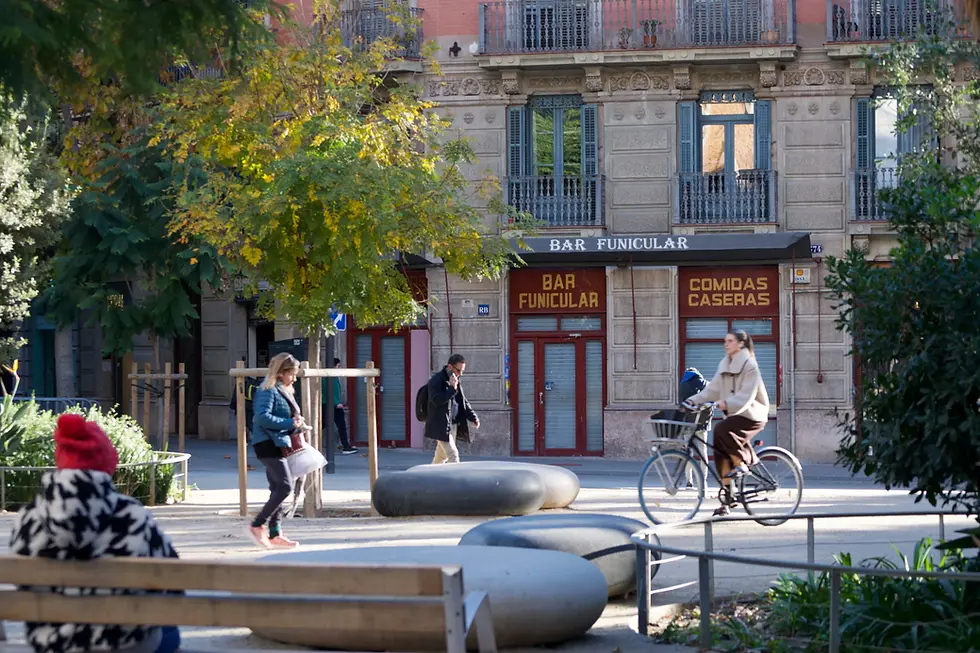
Step outside Hostal Girona and look up. You're standing on Carrer Girona, one of the quieter grids of the Eixample, and already the buildings are talking to you. Ceramic details catch the light, wrought iron balconies curl like branches, a facade that somehow feels alive. Most people walk past without stopping. But if you do stop, you start asking a question that turns out to be far more interesting than it first appears: why does Barcelona look like this?
The answer isn't just aesthetic. It's political, emotional, and deeply Catalan.
A Movement With Something to Prove Catalan Modernisme: More Than Mosaics

Modernisme emerged in the final decades of the nineteenth century and burned brightly until around 1920. On the surface, it belongs to the same European wave that produced Art Nouveau in France, Jugendstil in Germany, and Liberty style in Italy. Flowing lines, natural forms, ornamental richness. You'll recognise the family resemblance.
But in Catalonia, the style carried a weight it didn't carry elsewhere. Many of the architects and intellectuals who drove the movement were socialists, nationalists, and cultural patriots. This was the era of the Renaixença, a conscious revival of Catalan language, literature, and identity after centuries of political suppression. Building in this new style wasn't just an aesthetic choice. It was a statement: we exist, we have a culture, and it is worth celebrating in stone.
Look at the national motifs woven into facades, the dragons, the Catalan flags rendered in ceramic, the references to medieval Catalan heroes. These aren't decorations. They're arguments. Catalan Modernisme: More Than Mosaics
[If you want to understand where this cultural confidence came from, our article on Medieval Barcelona traces the roots: the Gothic golden age that Modernista architects were consciously echoing and reclaiming.]
The Stage: A City Being Reinvented

You can't understand Modernisme without understanding the Eixample, the vast grid of octagonal blocks that spreads out from the old city like a geometric dream. In the 1860s, Barcelona was suffocating inside its medieval walls. The engineer Ildefons Cerdà drew up a radical plan for expansion: wide avenues, chamfered corners to ease circulation, green spaces at every block. A city designed for modern life.
What Cerdà gave the city was a blank canvas. What the industrial and rural bourgeoisie of Catalonia — newly wealthy, culturally ambitious, and fiercely proud — did with it was extraordinary. They hired the greatest architects of their generation to fill those blocks with buildings that would announce their success and their identity simultaneously. The result is what you see today on Passeig de Gràcia and the surrounding streets: the densest concentration of Modernista architecture in the world.
[We go deep on the urban story in our article The Birth of the Eixample, worth reading alongside this one.]
Three Masters, Three Visions
Modernisme wasn't a single style so much as a shared ambition expressed through radically different personalities. Three architects defined it above all others.
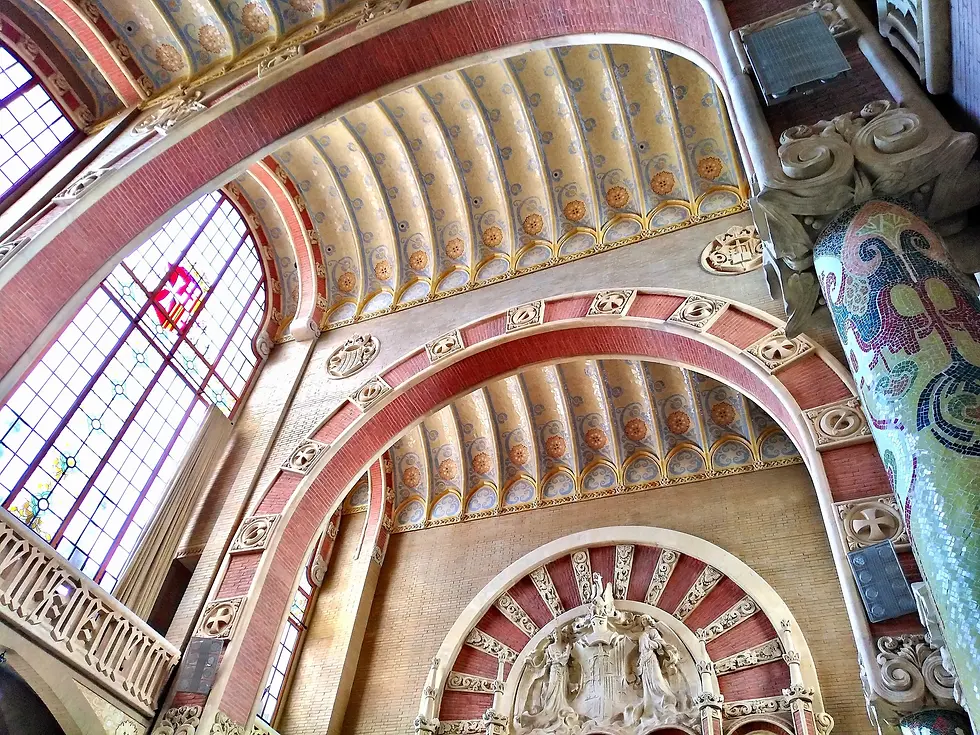
Lluís Domènech i Montaner was perhaps the movement's great intellectual. His architecture combined structural rationalism with decoration drawn from Hispano-Arab traditions, a synthesis that was both technically innovative and visually overwhelming. Stand inside the Palau de la Música Catalana and you understand immediately: light, colour, and craftsmanship working together as a single argument about what architecture can do. His Hospital de Sant Pau, built as a functioning medical complex and now a UNESCO site, shows the same conviction: that beauty and utility are not opposites.
Josep Puig i Cadafalch brought a historian's eye to architecture. A trained archaeologist as well as an architect, he was obsessed with Catalan Gothic heritage and filtered it through influences from Dutch and German Gothic to create something sharp, symbolic, and deeply rooted in memory. Casa Amatller on Passeig de Gràcia, with its stepped gable and intricate stone carving, is his most celebrated work, one that rewards close attention. Where Domènech overwhelms you with warmth, Puig i Cadafalch rewards patience.
Antoni Gaudí stood apart from everyone. His contemporaries were reviving history; he was doing something stranger and more ambitious. Gaudí looked at nature, at bones, shells, coral, the branching logic of trees, and asked what architecture would look like if it obeyed the same structural laws. The result was a formal language entirely his own: hyperbolic paraboloids, helicoids, hyperboloids, geometric forms derived not from historical styles but from the geometry of the natural world. Casa Milà ripples like a cliff face. The Sagrada Família grows like a forest. These aren't buildings that imitate nature's appearance. They embody its principles.
His long collaboration with the industrialist Eusebi Güell was central to all of this. That sustained patronage produced some of Gaudí's most iconic works: the Dragon Gate, Park Güell, and Palau Güell. Without it, his most radical ideas might never have been built.

Beyond Barcelona

Here's something the average Modernisme article won't tell you: this wasn't only a Barcelona story. The style spread across Catalonia, adopted by cities with their own bourgeoisies, their own pride, their own architects.
Reus, Gaudí's birthplace, has a remarkable Modernista legacy, including Domènech i Montaner's Instituto Pere Mata and the exuberant Casa Navàs. Girona, Tarragona, and Lleida all carry traces of the movement in their streets. When you travel through Catalonia with this in mind, you start noticing it everywhere: a tiled shopfront, a wrought iron lamppost, a corner building with just a little too much going on at the roofline.
[On Carrer Girona itself, just outside the hostal, you'll find some of these quieter, less-photographed gems. We've written a guide to the Modernista buildings on this street if you want to explore with context.]
Living Inside the Museum
Most architectural movements end up behind glass. Catalan Modernisme is still lived in: offices, apartments, shops, pharmacies with original wooden cabinets and ceramic lettering. The buildings on your walk to the supermarket are the buildings.
That's what makes staying in the Eixample different from visiting it. You're not looking at Modernisme from the outside. You step out of the door each morning and it's simply there, in the iron of the lift gate, the hydraulic tiles underfoot, the light falling through a stained-glass landing window. Gaudí's quote — originality is about going back to the roots — starts to mean something different when the roots are literally all around you.
Sources:
casanavas.cat
amatller.org


Comments